
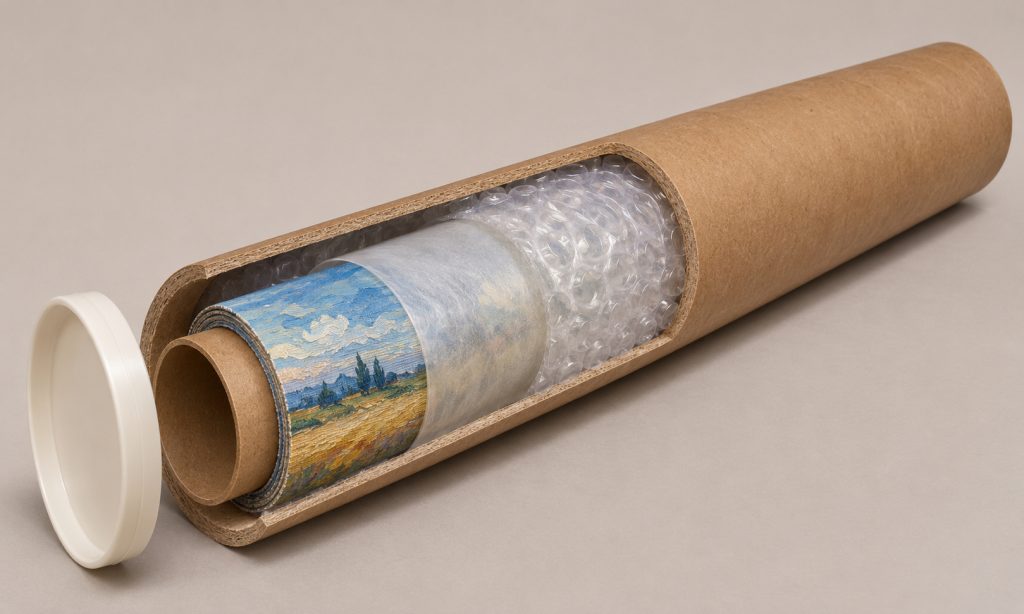
Cardboard Tubes as Inner Cores
Wrapping artwork around a narrower inner core before inserting it into a wider outer postal tube is the industry-preferred method for shipping delicate rolled items. This tube-in-tube shipping technique prevents the artwork from uncurling,creasing, or collapsing under pressure during transit.
Huge Range of Diameters and Lengths of Cardboard Tubes
Because we hold one of the UK’s widest selections of cardboard tube diameters, wall thicknesses, and lengths in stock,pairing the right inner core with a protective outer postal tube is straightforward:
38mm (1.5″) Inner Cores: Ideal for lightweight prints, posters, and photographs, easily nesting inside 76mm (3″)or 101mm (4″) outer postal tubes.
50mm (2″) Inner Cores: Commonly used for heavier media, thick fine art paper, and smaller unstretched canvases,safely housed inside 101mm (4″) or 152mm (6″) outer postal tubes depending on the final rolled thickness.
Large-Diameter Heavy-Duty Tubes (6″, 8″, and 10″): For oversized artwork, thick oil canvases, and wide-diameter rolled pieces, we hold 152mm (6″), 203mm (8″), and 254mm (10″) diameter postal tubes in stock with extra-strong, thick walls to prevent crushing in transit. These wider tubes work both as gentle, wide-radius inner cores for fragile oil paintings and as heavy-duty outer postal tubes.
Bespoke Sizes: Need an exact fit for a unique consignment? We manufacture custom postal tubes and cardboard cores cut to your precise diameter, wall thickness, and length specifications.

How to Roll and Post Artwork Safely (Including Unstretched Oil & Acrylic Canvases)
Posting original artwork, giclée prints, or unstretched canvases requires more than simply rolling the piece and sliding it into a tube. Tight rolling or improper wrapping can cause paint to crack, edges to fray, or moisture to damage the surface.
Follow this step-by-step guide to prepare and post your artwork safely using the double-tube core method.
1. Choose the Right Inner Core and Outer Tube
Never roll valuable artwork tightly around itself without a core. A narrow bend puts extreme tension on paper fibres and dried paint layers.
- For Fine Art Prints & Posters: Use at least a 38mm (1.5″) or 50mm (2″) diameter core inside a 76mm (3″) or 101mm (4″) outer tube.
- For Oil & Acrylic Paintings on Canvas: Dried oil and acrylic paint can crack if bent too sharply. Always use a wider inner core—ideally 76mm (3″) to 152mm (6″) in diameter—paired with one of our heavy-duty 152mm (6″), 203mm (8″), or 254mm (10″) thick-walled outer postal tubes for maximum crush resistance.
- Length Allowance: Ensure both tubes are at least 50mm to 100mm (2″ to 4″) longer than the artwork itself to protect the edges from impact damage.
2. Prepare Your Workspace and Protective Layers
Clear a clean, flat surface larger than your artwork. Wash and dry your hands, or wear cotton archival gloves to prevent natural oils from transferring onto the canvas or paper.
- Lay down a sheet of acid-free tissue paper or glassine paper slightly larger than the artwork.
- Place your artwork face-up on top of the protective sheet.
- Lay a second sheet of acid-free tissue or glassine directly over the painted or printed surface. (Note: Never use standard bubble wrap directly against an oil or acrylic painting, as the plastic can stick to the varnish or leave permanent circular impressions in the paint).
3. Roll the Artwork Around the Inner Core
- Paint Side Out for Canvases: When rolling an oil or acrylic painting that has been removed from its stretcher bars,always roll it with the painted side facing outwards. Rolling a canvas paint-side in compresses the paint layer,causing it to buckle, flake, or crack. Rolling paint-side out gently stretches the paint film rather than crushing it.
- Align Carefully: Place your chosen cardboard core parallel to one edge of the sandwich (tissue paper, artwork,tissue paper). Gently lift the edge over the core and begin rolling smoothly, keeping the tension even and relaxed—never pull it tight.
- Secure the Roll: Once fully rolled, wrap a final layer of kraft paper or glassine around the outside and secure it with low-tack artist’s tape or masking tape. Never apply tape directly to the artwork or canvas.
4. Cushion and Insert into the Outer Postal Tube
- Wrap the rolled core in a single layer of bubble wrap to act as a shock absorber and prevent the inner roll from rattling inside the outer tube.
- Gently slide the wrapped core into your wider, thick-walled outer postal tube (such as our 6″, 8″, or 10″ heavy-duty tubes for larger pieces).
- Fill any remaining empty space at either end of the outer tube with scrunched acid-free tissue paper or foam padding so the inner core cannot shift vertically during transit.
5. Seal and Label for Transit
- Fit heavy-duty end caps or plugs firmly into both ends of the outer tube. For high-value shipments and large-diameter tubes, secure the ends in place using strong parcel tape wrapped around the circumference of the tube.
- Attach a clear shipping label along the length of the tube rather than wrapping it around the circumference—this ensures barcode scanners at courier depots can read the label easily.