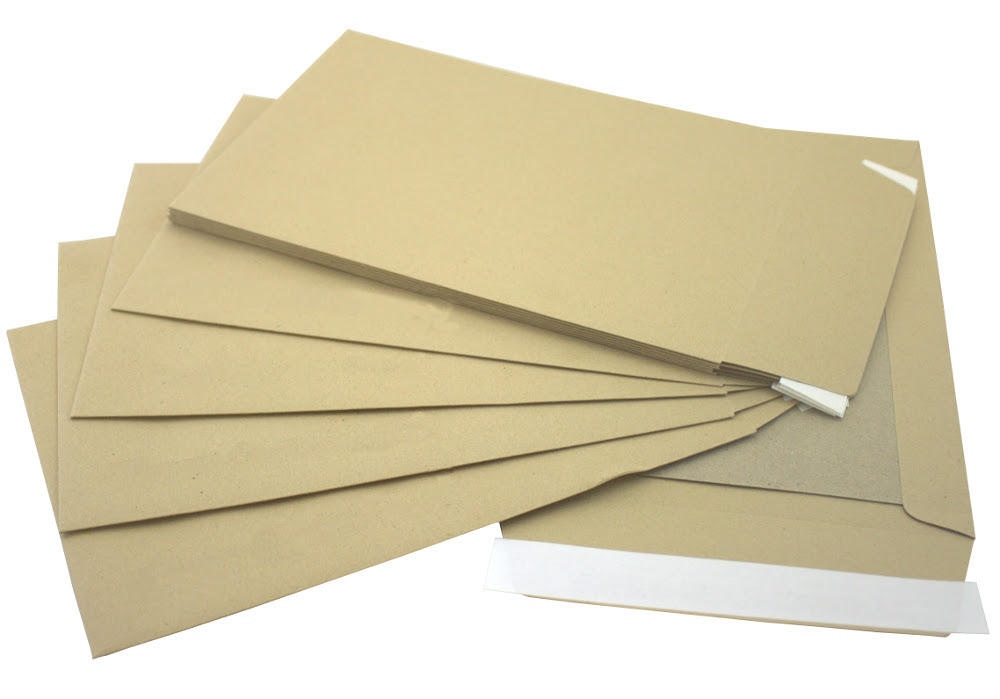
Board backed envelopes are one of the simplest ways to protect important documents, photographs, certificates and artwork in the post.
Unlike an ordinary paper envelope, a board backed envelope has a rigid card backing that helps prevent the contents from bending, folding or creasing while in transit.
They are widely used by businesses, schools, offices, photographers, artists, solicitors and anyone who needs to send flat items safely through the post.
If you already know what you need, you can browse our board backed envelopes range here.
What Is a Board Backed Envelope?
A board backed envelope is a paper mailing envelope with a rigid cardboard backing.
The board gives the envelope extra strength and helps keep the contents flat while they are being handled, sorted and delivered.
They are often printed with the words “Please Do Not Bend” to alert postal and courier staff that the contents should remain flat.
You may also hear them described as:
- hard backed envelopes
- hard back envelopes
- card backed envelopes
- rigid envelopes
- Do Not Bend envelopes
All of these terms generally refer to the same type of protective postal envelope.
What Are Board Backed Envelopes Used For?
Board backed envelopes are useful whenever the contents could be damaged by bending or creasing.
Typical uses include sending:
- certificates
- contracts
- legal documents
- photographs
- artwork
- prints
- reports
- presentations
- brochures
- application forms
- educational documents
- important business paperwork
They are especially useful when the contents need to arrive looking professional.
A folded or creased certificate, photograph or presentation can create a poor impression, even if the contents themselves are still readable.
Why Use Board Backed Envelopes Instead of Ordinary Envelopes?
Ordinary envelopes are designed mainly to contain and conceal documents.
They offer very little protection against bending.
Board backed envelopes add a rigid layer of card behind the contents, giving the package greater resistance to folding and creasing.
This makes them a better choice for anything that needs to remain flat.
For everyday letters, a normal paper envelope is usually sufficient.
For certificates, photographs, artwork, reports and other important flat items, a board backed envelope offers much better protection.
What Size Board Backed Envelope Do I Need?
The easiest way to choose a board backed envelope is to match the envelope size to the paper or document size you are sending.
As a general guide:
| Item | Recommended envelope size |
|---|---|
| A6 document or small photograph | C6 |
| A5 document | C5 |
| A4 folded once | C5 |
| A4 document unfolded | C4 |
| A3 document unfolded | C3 |
| Large artwork or prints | C3 or specialist oversized envelope |
The envelope should be slightly larger than the document so the contents can be inserted without forcing them.
Not sure which version you need? Browse all board backed envelopes by size and style.
What Size Board Backed Envelope Fits A4 Paper?
For an A4 document that needs to remain unfolded, a C4 board backed envelope is normally the best choice.
A4 paper measures 210mm x 297mm, while a standard C4 envelope is approximately 229mm x 324mm.
This leaves enough room for the document to fit comfortably while keeping it flat.
C4 board backed envelopes are commonly used for:
- certificates
- contracts
- reports
- photographs
- artwork
- business documents
- presentations
Defenda Packaging stocks several types of C4 board backed envelope, each suited to a slightly different purpose.
For general business documents, our standard C4 board backed envelopes provide a strong everyday option.
Where reducing postal weight is important, our lightweight C4 board backed envelopes may be more suitable.
For particularly delicate documents, photographs or artwork, choose C4 board backed envelopes with stiffeners for additional rigidity.
We also stock white C4 board backed envelopes and white C4 window board backed envelopes where presentation is especially important.
See all C4 and A4 board backed envelope options
What Size Envelope Fits A5 Paper?
For A5 documents, a C5 board backed envelope is usually suitable, as well as C5 PIP board backed envelopes.
C5 envelopes are also commonly used for A4 documents that have been folded once.
They are useful for smaller brochures, booklets, reports and general business correspondence that requires more rigidity than a standard envelope.
Defenda stocks both standard and postal-focused C5 formats, so it is worth comparing the available sizes before ordering.
What Size Envelope Fits A3 Paper?
For A3 documents that must remain unfolded, a C3 board backed envelope is normally required.
These larger envelopes are often used for:
- artwork
- architectural drawings
- plans
- large certificates
- oversized documents
- presentation materials
- posters and prints
Defenda supplies standard C3 envelopes as well as reinforced and white versions.
For general A3 documents, choose standard C3 board backed envelopes.
For valuable artwork or documents requiring additional rigidity, C3 board backed envelopes with stiffeners provide greater resistance to bending.
White versions are also available where appearance and presentation are important.
What Is the Difference Between C3, C4, C5 and C6 Envelopes?
Envelope sizes follow the international C-series paper system.
The main sizes used for board backed envelopes are:
C6 – suitable for A6 documents
C5 – suitable for A5 documents or A4 folded once
C4 – suitable for A4 documents without folding
C3 – suitable for A3 documents without folding
The larger the number, the smaller the envelope.
So C3 is larger than C4, and C4 is larger than C5.
For these generic size terms, I would usually link to the category rather than to a single product because Defenda stocks multiple versions in several sizes.
Are Board Backed Envelopes the Same as Hard Back Envelopes?
Yes, in most cases.
The terms board backed envelope, hard backed envelope, hard back envelope and card backed envelope are commonly used to describe the same type of product.
Different manufacturers and retailers may use slightly different terminology, but the principle is the same: a paper envelope with a rigid backing designed to help protect flat contents.
Are Board Backed Envelopes Suitable for Photographs?
Yes.
Board backed envelopes are a popular choice for posting photographs because they help protect prints against bending and creasing.
Defenda also supplies a dedicated photograph size board backed envelope, which may be more suitable where a standard C-series envelope leaves unnecessary excess space.
For valuable photographs, fine art prints or particularly delicate items, additional protection may be sensible.
This could include:
- placing the photograph between two sheets of card
- using a cardboard envelope stiffener
- using a reinforced board backed envelope
- placing the envelope inside a larger protective mailer
Are Board Backed Envelopes Suitable for Certificates?
Board backed envelopes are ideal for posting certificates.
Certificates often need to arrive in good condition because they may be framed, displayed or presented formally.
A C4 board backed envelope is usually the most appropriate size for a standard A4 certificate.
For particularly important certificates, adding an envelope stiffener can provide greater protection.
Can I Post Artwork in a Board Backed Envelope?
Yes, provided the artwork is relatively flat and not excessively fragile.
Board backed envelopes are commonly used for:
- prints
- illustrations
- drawings
- photographs
- small pieces of artwork
For A4 artwork, a C4 envelope will usually be suitable, while larger A3 work will normally require a C3 envelope.
For valuable or highly delicate artwork, a more rigid cardboard mailer may be a better choice.
The packaging should always be selected according to the value, fragility and thickness of the contents.
Board Backed Envelopes vs All-Board Envelopes
These two products are similar but provide different levels of protection.
A board backed envelope normally has a rigid cardboard back with a paper front.
An all-board envelope or cardboard mailer uses rigid board on both sides.
This means an all-board mailer usually provides greater resistance to bending and impact.
As a general guide:
Board backed envelopes are ideal for documents, certificates, photographs and everyday flat items.
All-board envelopes are better where greater rigidity or protection is required.
Board Backed Envelopes vs Gusset Envelopes
Board backed envelopes and gusset envelopes solve different problems.
Board backed envelopes are designed mainly to prevent bending.
Gusset envelopes are designed to provide extra capacity for thicker contents.
A gusset envelope may be better for:
- thick reports
- catalogues
- manuals
- document packs
- booklets
A board backed envelope may be better for:
- certificates
- photographs
- artwork
- documents
- prints
If you need more capacity rather than rigidity, take a look at our gusset envelopes.
If the item is both thick and fragile, a box or specialist cardboard mailer may be more suitable.
What Does “Please Do Not Bend” Mean?
Many board backed envelopes are printed with the words “Please Do Not Bend.”
This acts as a clear instruction to postal and courier handlers that the contents should remain flat.
However, the wording itself does not guarantee that an envelope will never be bent.
The real protection comes from the strength of the board.
For valuable or delicate contents, choose a stronger envelope or add a cardboard stiffener rather than relying on the printed warning alone.
What Is an Envelope Stiffener?
An envelope stiffener is a flat piece of cardboard placed inside an envelope to increase rigidity.
It can be useful when sending:
- photographs
- artwork
- certificates
- important documents
- presentation materials
A stiffener helps reduce the risk of the contents being bent even if pressure is applied to the envelope.
Defenda Packaging supplies cardboard envelope stiffeners in several sizes for use with board backed and other mailing envelopes.
Heavy Duty or Lightweight Board Backed Envelopes?
Not every mailing requires the heaviest possible envelope.
Heavy-duty board backed envelopes are useful where protection is the main priority.
Lightweight versions may be a better choice where keeping the total postal weight low is important.
Choose a heavier envelope for:
- valuable documents
- photographs
- artwork
- certificates
- items that must remain very flat
Choose a lighter envelope where:
- the contents are less fragile
- postal weight matters
- you are sending large volumes
- the contents already have some rigidity
For standard A4 documents, compare our C4 board backed envelope options to choose between standard, lightweight c4 board backed envelopes, C4 Tariff Beater and reinforced designs.
Can Board Backed Envelopes Be Sent as Royal Mail Large Letters?
Some board backed envelopes may fall within Royal Mail Large Letter dimensions, depending on their size.
However, the final postal format depends on the complete package, not just the empty envelope.
You must consider:
- length
- width
- thickness
- total packed weight
Adding documents or stiffeners can increase both thickness and weight.
Always check the latest Royal Mail size and weight limits before posting.
If postal size and weight are a major consideration, compare our PiP and lightweight board backed envelopes.
How Do You Choose the Best Board Backed Envelope?
There are four main things to consider.
1. Size
Choose an envelope slightly larger than the item you are sending.
C4 is usually correct for unfolded A4 documents, while C3 is suitable for A3.
2. Rigidity
Think about how vulnerable the contents are to bending.
A photograph or certificate may need stronger protection than an ordinary business document.
For added rigidity, consider an envelope supplied with stiffeners or add a separate cardboard envelope stiffener.
3. Weight
Heavier envelopes provide more rigidity but also add more weight to the finished package.
Where postal weight matters, consider one of our lightweight board backed envelopes.
4. Presentation
White board backed envelopes can provide a more professional appearance for customer-facing documents, certificates and formal correspondence.
Brown manilla versions are often ideal for general commercial use.
Common Uses by Envelope Size
C6 Board Backed Envelopes
Best suited to:
- small photographs
- postcards
- invitations
- A6 documents
- small printed items
Defenda stocks both Classic and PiP C6 formats.
C5 Board Backed Envelopes
Best suited to:
- A5 documents
- folded A4 paperwork
- brochures
- smaller photographs
- booklets
C4 Board Backed Envelopes
Best suited to:
- A4 documents
- certificates
- contracts
- reports
- photographs
- artwork
- presentations
Because Defenda stocks several C4 designs, it is best to compare the full C4 board backed envelope range before choosing.
C3 Board Backed Envelopes
Best suited to:
- A3 documents
- larger artwork
- plans
- drawings
- prints
- oversized presentation materials
Where Can I Buy Board Backed Envelopes?
Defenda Packaging stocks a wide range of board backed and hard backed envelopes for businesses and individuals throughout the UK.
The range includes:
- C6 board backed envelopes
- C5 board backed envelopes
- C4 / A4 board backed envelopes
- C3 / A3 board backed envelopes
- white board backed envelopes
- window envelopes
- lightweight postal envelopes
- reinforced envelopes
- envelopes with additional stiffeners
- photograph size envelopes
- specialist oversized envelopes
Different sizes, styles and quantities are available depending on your requirements.
Browse the complete Board Backed Envelopes range
If you are not sure which envelope you need, start by identifying the size of the item you are sending and whether your priority is rigidity, low postal weight or maximum protection.
Choosing the Right Board Backed Envelope
The most important rule is simple: choose an envelope that fits the item properly and provides enough rigidity for the contents.
For ordinary paperwork, a standard board backed envelope is usually sufficient.
For valuable photographs, artwork or certificates, a stronger envelope or additional stiffener can provide extra reassurance.
And if the item is particularly thick, heavy or fragile, consider using a more rigid cardboard mailer instead.
Choosing the right packaging helps your documents arrive flat, protected and ready to use.